


Given the popularity of “the doctrine of discovery” these days, I find it fascinating that that specific phrase never appears even one time in the Johnson v. McIntosh ruling of 1823. Chief Justice Marshall wrote instead about “the right of discovery,” a right and principle which Marshall said was a consequence of the John Cabot Commission of 1496.
“No one of the powers of Europe gave its full assent to this principle {of discovery} than England,” wrote Marshall for a unanimous Court in Johnson. He continued: “The documents on this subject are ample and complete. So early as the year 1496, her {England’s} monarch granted a commission to the Cabots {i.e. John Cabot and his sons} to discover countries then unknown to Christian people and to take possession of them in the name of the King of England.”
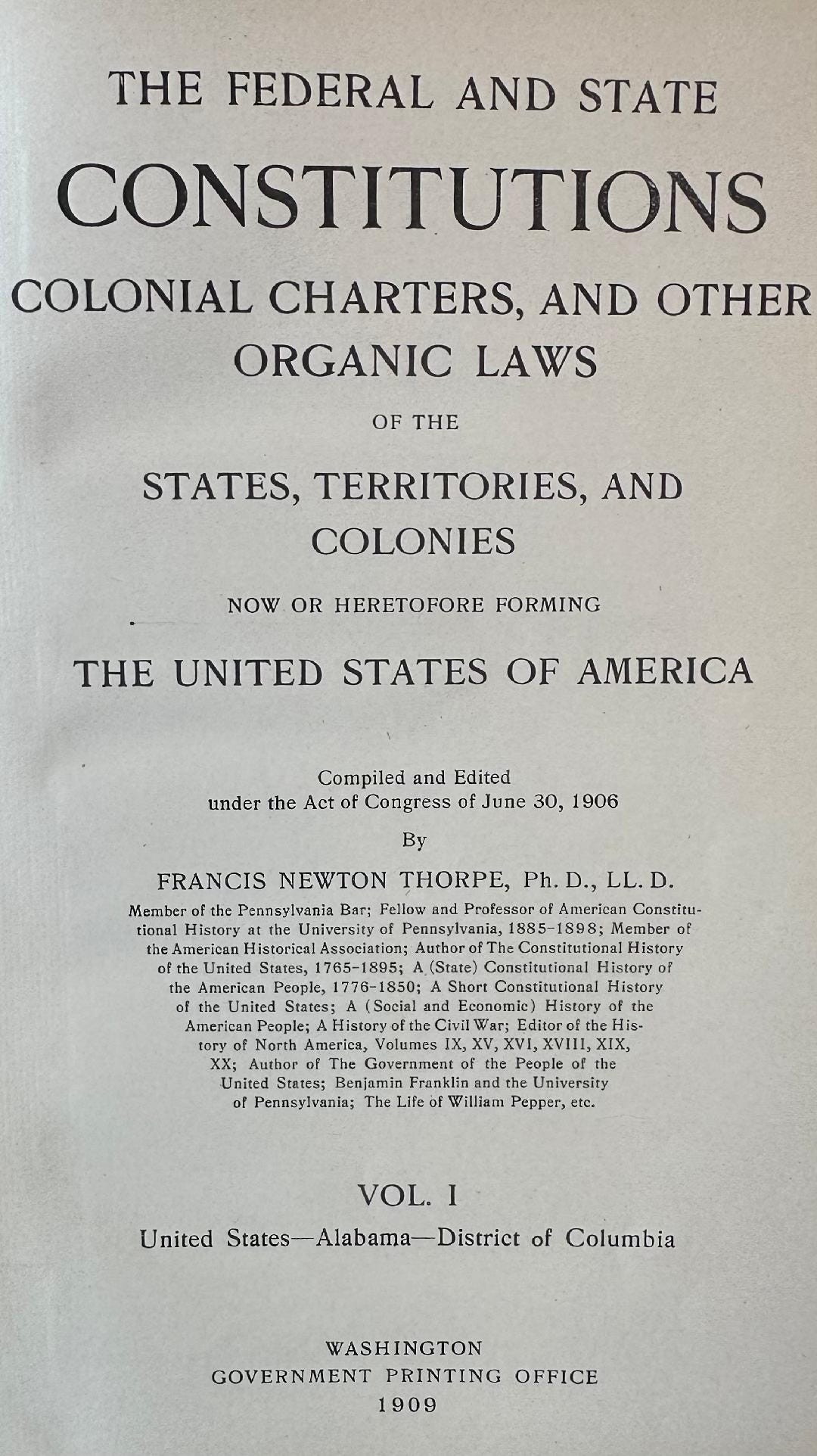
Volume I of Federal and State Constitutions Colonial Charters, and Other Organic Laws of the States, Territories, and Colonies Now or Heretofore Forming the United States of American, edited by Francis Newton Thorpe, was published in 1909, pursuant to a 1906 order of Congress. It was published by the Government Printing Office in Washington, D.C. In that volume is a copy of the Latin version of the original “Letters Patent to John Cabot,” originally written in Latin and translated into English. It’s dated March 5, 1496.
The Latin title reads “Pro Johanne Caboto & Filiis suit super Terra Incognita Investiganda.” “For John Cabot & Sons” to “Investigate {Search for} Unknown Land.”
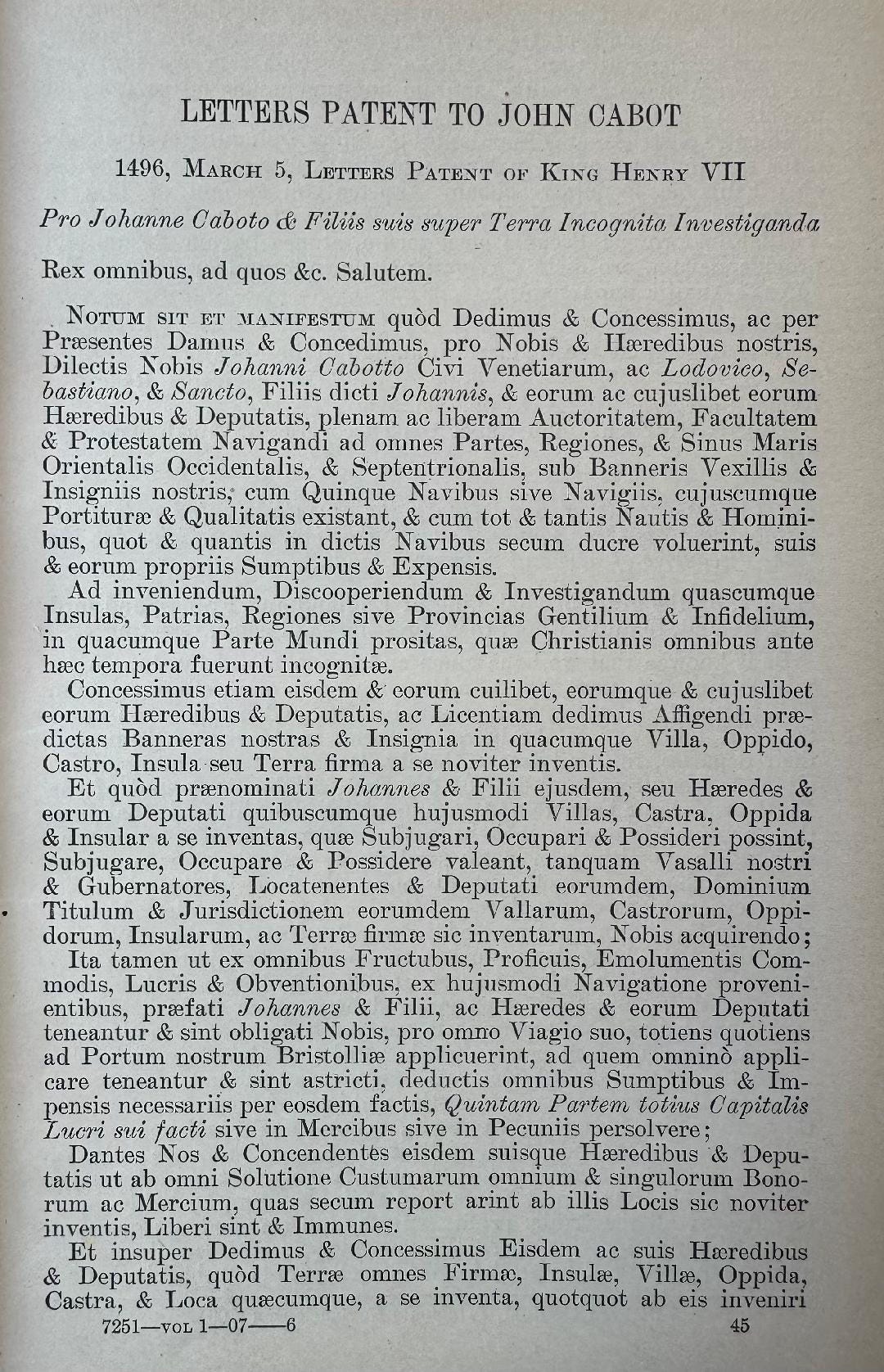
If and when the Cabots succeeded in sailing to and identifying distant lands of Heathens and Infidels {“Gentilium & Infidelium”} they were directed by the king to Dominate, Occupy, and Possess {“Subjugari [ie. Subjugate], Occupari, & Possideri”} those places.
Chief Justice Marshall continued, “Two years afterwards {John} Cabot proceeded on this voyage and discovered {identified the location of} the continent of North America, along which he sailed as far south as Virginia.” “To this document the English trace their title {to the lands of this continent},” said Marshall.
“In this first effort by the English government to acquire territory on this continent we perceive a complete recognition of the principle {of discovery} which has been mentioned. The right of discovery [emphasis added] given by this [Cabot] commission is confined to countries ‘then unknown to all Christian people.” {Marshall’s original emphasis}
Marshall continued by saying that John Cabot “was empowered {by the king’s Letters Patent} to take possession {of countries previously unknown to Christian people} in the name of the King of England. Thus {thereby} asserting a right to take possession notwithstanding the {prior} occupancy {and free existence} of the natives, who were heathens {& infidels}, and at the same time admitting the prior title of any Christian people who may have made a previous discovery.”
According to the Supreme Court, “Christian people” were able to claim a “title” of “ultimate dominion” [domination] to and over previously unidentified non-Christian lands. The Latin version of the Cabot charter uses a term that means a domination title or a title of domination and jurisdiction {“Dominium Titulum & Jurisdiction”}.”
A “right of discovery” and “a right to take possession,” by means of domination, were purportedly “given” by King Henry VII to the Cabots by the wording of the king’s commission to them.
What the U.S. Supreme Court called a “right of discovery” tells us that a first “discovering” Christian monarch was recognized by the other monarchs of Christendom as having the royal power to claim to “take possession” of a newly identified geographical area where heathens and infidels already living.
What the Supreme Court emphasized in the Johnson ruling was the difference between the Christian Europeans’ asserted right of dominium [domination], and what the Court diminishingly called the “mere occupancy” of the Indians.
The U.S. Supreme Court explained that the royal commission issued to the Cabots had “empowered” them “to take possession” of the land, and to do so “in the name of” the King of England. And this was regardless of the fact that non-Christian Native nations and peoples were already living “on the land” with their own prior possession of the places where they had lived for an untold number of generations, free and independent of any Christian domination.
What we end up with, therefore, is a competition and conflict between the interests of the Native nations and peoples living on the land, and the purported “right” and intention of the monarch’s royal subjects, such as the Cabots, to use any and all means of domination to purport to take possession of the lands of “natives, who were heathens” and to do so “in the name of the English king.”
What the U.S. Supreme Court expressed in the Johnson ruling of 1823, was a story of a “Christian people” who had sent representatives sailing across the ocean on the basis of a claim that their king had, by means of his “royal prerogatives,” had “given them” a “right” to use symbology and brute force to establish a system of domination over any distant lands where non-Christian Native nations and peoples are already living free and independent of such foreign control.
Thus, the Johnson v. McIntosh ruling tells the story of a foreign “Christian people” from Western Europe invading distant lands, and then claiming a right of domination in relation to those lands, and in relation to the Native nations and peoples already living there with their own free way of life.
This, then, succinctly stated, is the claim of a right of Christian domination in relation to non-Christian nations and peoples and their lands, which has been typically and somewhat erroneously referred to as “the doctrine of discovery.” The claim of a right of domination forms the premise of the entire anti-Indian system of ideas and arguments called “federal Indian law and policy.”
That claim of a right of domination, and the ideas and arguments extending from that claimed right, are used on an ongoing basis by the U.S. government against Native nations and peoples. An assertion of a right of domination forms an integral part of the fundamental organic laws of the United States.
“the claim of a right of Christian domination in relation to non-Christian nations and peoples and their lands, which has been typically and somewhat erroneously referred to as “the doctrine of discovery.” The claim of a right of domination forms the premise of the entire anti-Indian system of ideas and arguments called “federal Indian law and policy.”
Yes. To call it a ‘doctrine’ misses the fact that it is a CLAIM. A claim of a ‘right’.